There are a few different definitions but they generally describe the same philosophy: “a political theory that posits the United States as a unique nation, distinguished by its commitment to democracy, liberty, and self-governance.” And further, that uniqueness makes it a “model for the world.” (Ruth, Michael 2025, Ebsco.com) there are three essential parts of this concept that need to be dismantled.
- The United States is committed to democracy, liberty and self-governance.
- That these qualities make the United States unique. And,
- Other countries should do what the US did to get this way.
I’ll focus primarily on dismantling the first point because it naturally leads to the dissolution of 2 and 3.
Is the US Committed to Democracy, Liberty, and Self-Governance?
The United States is not, and never has been, committed to democracy, liberty, or self-governance unless you restrict your definition of “Americans” to white, land-owning, Christian men. This is something that a lot of modern Americans are comfortable doing, because expanding that population inherently disrupts a rosy world view of Americans as exceptionally moral. If you scratch that veneer by pointing out mistreatment of indigenous people, women, or black people, you find an underlying defensive ruthlessness - responses such as “well, we won the war fair and square.” Or “that was a long time ago, get over it.” Neither of those statements are accurate - colonization, and resistance to colonization by indigenous people, is occurring every day. Since indigenous people of North America comprise several hundred independent governance organizations, no war was ever fought and won against all of them.
The world view of American Exceptionalism is so pervasive that individuals consider any threat to the idea that America is extremely moral as a threat to their individual moral character. This is a feature, not a bug. When someone equates criticism of America to criticism of their own morality, it becomes very difficult to question the underlying values of American patriotism without devolving into ad hominem attacks and accusations of hatred. Defensiveness about individual identity insulates the broader American identity from criticism.
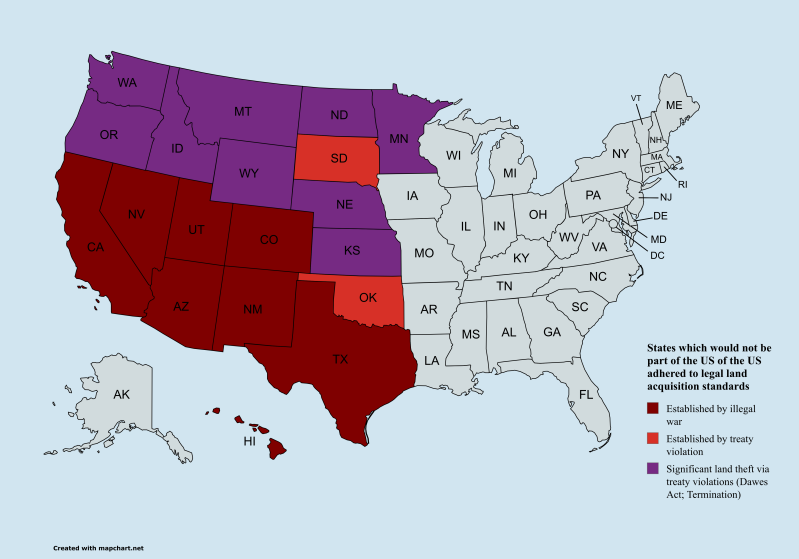
There are so many examples of the US Government and the American public failing to uphold the values of Democracy, Liberty, and Self-Governance, many of which are fundamental to the existence of the United States at all, that it is essentially a meaningless statement. Here are some of the broadest examples that demonstrate that the United States would not exist if it honored those values:
- 1776 Constitutional Convention: only white, educated, land-owning men were allowed to take part in the drafting of the US constitution. Predictably, this resulted in a Constitution that only granted full citizenship to white, land-owning men.
- 1846 Mexican American War: President James Polk sent US troops into Mexico in order to invent a justification to Congress for declaring a war against Mexico, violating the separation of powers laid out in the Constitution. He later lied to Congress about Mexico inciting violence, leading Congress to nearly unanimously declare war.
- 1876 taking of the Black Hills: the 1868 Treaty of Fort Laramie set aside 44 Million acres of the Black Hills for the exclusive use of the Lakota people - essentially the western half of South Dakota. In 1874, Federal troops illegally intruded into the reserved Sioux territory and found gold, triggering a settler invasion, or “gold rush” into the reserved land. In 1980, the US Supreme Court acknowledged that the Black Hills were illegally taken, and ordered the US to pay for the land, plus over 100 years of interest.
- 1887 Allotment Act: treaties are agreements made between equal and independent sovereigns. Typically both parties must agree to change the terms of a treaty. But with the General Allotment Act, Congress unilaterally decided that tribal people had reserved too much land for themselves, and in order to force assimilation, they parceled out farm lots for each Tribal individual or family, and sold the “surplus” reservation land to settlers.
- 1903 Oklahoma Statehood: Oklahoma was originally designated as an Indian reservation in 1830 where tribal people from east of the Mississippi were forcibly removed to during the Trail of Tears. By 1890 the Indian part of the territory was reduced by half, and after the establishment of the Oklahoma state, it was essentially forgotten that the western half of Oklahoma was still reserved to the Tribes who were forced to settle there. The continuing status of the Western half of the state as an Indian Reservation was recently acknowledged in the SCOTUS case McGirt v. Oklahoma (2020).
- 1959 Hawaiian Statehood: In 1900, the US military supported an illegal coup of the Hawaiian monarch by white settlers, and the territory of Hawaii was established. In 1959, residents of Hawaii were asked in a ballot whether to remain a territory or become a US state. Statehood Hawaii notes that “One of the many obligations as stated in U.N. Resolution 742 in 1953 declares that one of the “factors indicative of the attainment of independence or of other separate systems of self-government,” is “freedom of choosing on the basis of the right of self-determination of peoples between several possibilities including independence.”” In the case of Hawaii, independence was not an option, and native Hawaiians never forfeited their sovereignty.
These are just a few examples of how this country would not exist if it truly lived up to the fabled values of Democracy, Liberty, and Self-Governance. Clearly, the states of Oklahoma, South Dakota, Texas, California, Colorado, Utah, Arizona, New Mexico, Nevada, and Hawaii would not be US states if the US truly adhered to the stated principles of leadership by the consent of the governed. The 1883 Dawes Act and the 1953 Indian Termination Act represent an additional 90 million acres across the western US stolen by broken treaties, land which by rights reserved to themselves by Tribes, ought not be considered “America”.
This timeline should make the lie of the 2nd and 3rd assumptions of American Exceptionalism apparent. Do these qualities make America unique? America does not possess these qualities, except in a vague philosophical sense that has no grounding in reality. Other nations preceded America in governing democratically, such as Ancient Athens, Ancient India, and the Haudenosaunee Confederacy. The Haudenosaunee example demonstrates a much stronger commitment to equality, by establishing roles for men and women, and by rejecting caste hierarchy. The words are hollow, repeatedly broken promises.
American Exceptionalism is the myth that binds together a nation built on slavery and land theft by creating a pleasant fairy tale of democracy - however even that is being dismantled by the current Administration’s claim of “the enemy within” and “legal insurrection”, inventing enemies from those who oppose their policies through peaceful protest and the legal process.
Should other countries should do what the US did? They have done so, America is not unique as a colonizer. For about 400 years, European colonization has ravaged the entire world. No land or people remains un-scarred by that greedy and violent movement, from continued bloodshed in Africa, where the Zulu Empire fought to protect their people from English colonizers through the 1870s; to New Zealand where even today the legislature is attempting to erase the treaty rights of the Māori people; to the Middle East, where where Israel has been waging genocide against Palestinians since 1948, when anti-Semitic Americans and Western Europeans denied Jewish people safe haven from the Holocaust. European colonization has not ended; it has just been rebranded a few times.
Where do we go from here? We dismantle the mythology of American Exceptionalism by sharing knowledge and building community. We find a path to liberty through this oppressive system by claiming what is rightfully ours - freedom from colonial oppression, and true governance by the consent of the governed. We must build a new, decolonized, future.
Know Your Rights
Today we’ll discuss your right to record harm as a protective tool. There are two spheres where the right to record are distinctly different:
- In public, plainly visible spaces, such as parks and outside government facilities, and
- In private places, such as in a home, business, or on a phone call.
Although the Supreme Court hasn’t taken it up directly, it has been well established in case law in the 1st, 3rd, 7th, and 9th Circuit Courts that it is legal for a private citizen to record in public, provided they don’t violate laws in the process - for example, interfering with police, harassing someone, or invading someone’s “reasonable expectation of privacy”, such as peering inside their clothes or recording in a public restroom. Often written consent from a parent is required to share recordings of children, even when they are in public, so it’s best to avoid or blur their faces in video recordings.
States vary widely on the second point: recording in private spaces. In Oregon, all parties must consent to a conversation being recorded in-person, unless it is very clear that there is no expectation of privacy - for example, a public speech. Oregon requires one of the parties to consent to the recording of a telephone conversation, which means if you are part of the conversation and you are the one recording, no other consent is required. By contrast, Washington State requires all parties to consent to recordings for any conversation that falls under the “reasonable expectation of privacy” umbrella.
A more in-depth breakdown of Oregon’s recording laws can be found here:
https://www.shannonpowelllaw.com/blog/the-oregon-recording-laws-guide
And Washington’s here:
https://www.washingtonlawhelp.org/en/recording-someone#ea9d8558-a25a-4ea2-bbf4-fbeeec4fc2cf
Add comment
Comments